
The Griqua Town token coins (seen right) are often erroneously
referred to as South Africa's first indigenous coinage. Clearly they were
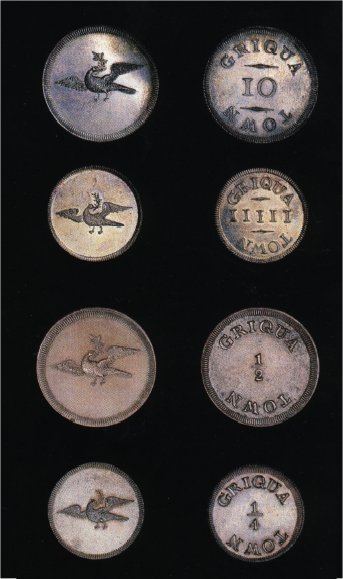 never used as currency by the Griquas at
Griqua Town in 1815/16. Even the London
Missionary Society admitted that they were a complete failure and were never
circulated (See
Karel Schoeman's research at this link
).
never used as currency by the Griquas at
Griqua Town in 1815/16. Even the London
Missionary Society admitted that they were a complete failure and were never
circulated (See
Karel Schoeman's research at this link
).
Griqua Town is located in Griqualand West about 150km from Kimberley, the epicenter of the South African diamond mining industry. It is one of the earliest settlements in central South Africa. It was previously known as "Klaarwater" the name change for, what was then a small village, came after a visit by the Rev John Campbell who recorded in his diary on the 7th August 1813,
"We had a meeting with all the male inhabitants of the settlement who were in the town (Klaarwater) to consider various points, especially about regulations for the protection of lives and property of the community…. every person present considered that laws should be made… The whole people likewise resolved that henceforth they should be called the Griquas instead of Bastard Hottentots and the place be called Griqua-town instead of Klaarwater".
It was Campbell who records the initial meeting in which the Griqua Town coins were discussed.
The region was administered by Great Britain from 1871, becoming part of the Cape Colony in 1880. There are two further Griqua pattern coins, one dated 1890 and the other of similar design but undated which were struck in minuscule quantities by Otto Nolte & Co. of Berlin, Germany, from dies prepared by L.C. Lauer of Nuremburg - they are extremely rare and have risen dramatically in price in the last couple of years.
All erroneous reference to these earlier Griquatown coins as currency circulating in 1815/16 can be tracked back to a poorly researched article written by H A Parsons for Spink in 1927 which is based on unsupported claims and unrealistic assumptions - it became accepted as numismatic fact until recently. Balson's research has now demonstrated that South Africa's first widely circulating indigenous currency was the trade tokens of Strachan and Company (1874 - 1932)
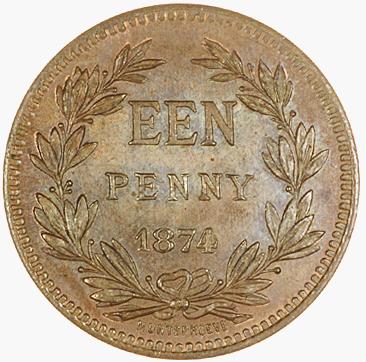
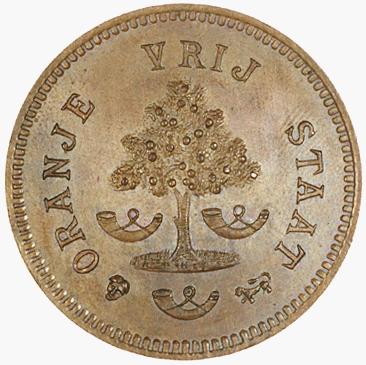
One of several Orange Free State Patterns struck between 1874 and 1888
Value in 2005: The Griqua town token coins were
highly sought after - and once valued at US$3,000 in Unc. Their value started falling in 2009 as reality struck in
[1815/16 Griqua Town "coins"]
[1860: Durban Club 6d] [1862 Durban
Bank £5 Bank Note] [1868: Griqua £1 Bank
Note]
[1874: Mount Currie Express Stamp]
[1874/1932: Strachan and Co Currency Tokens]
[1876 Pietermaritzburg Franklin Penny]
[Other E Griqualand Tokens] [1870s
Griqua Town Patterns] [1890: Griqua Patterns]
[Other Serious Griqua Coin Collectors]
[The History of the Griqua People]
[Griqua Token Coins, Coins and Bank Notes]
[Web Site Text Site Map]
[Tokencoins.com Home Page]
[Other South African Metal Token Coins]
See also article on Hern's latest (2008) misleading claims

